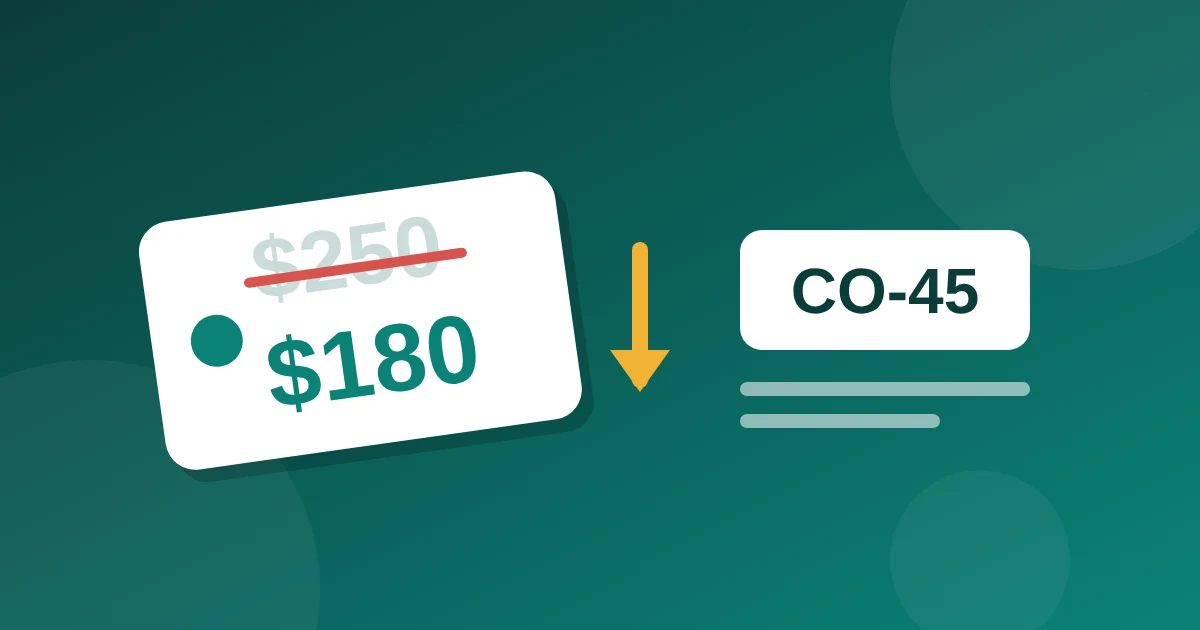
If you open a remittance and panic at a big CO-45 amount, take a breath. It's usually the most ordinary adjustment on the page, and most of the time it isn't a denial at all.
The standard definition, as Noridian words it, is: "Charge exceeds fee schedule/maximum allowable or contracted/legislated fee arrangement." Put simply, you billed more than the payer is allowed to pay for that service.
What it looks like in numbers
Say your fee for a service is $150 and your contract with the payer allows $110. The payer pays based on $110, and the other $40 is posted as CO-45. You agreed to that rate when you signed the contract, so the $40 is a contractual write-off. It isn't unpaid money, and it isn't something to chase.
The patient's share, such as a copay, deductible or coinsurance, is reported separately. Make sure your system collects that from the patient and writes off only the CO-45 part.
What to do with it
Usually nothing except post it correctly. Noridian's guidance lists no corrective action for CO-45, because it is a payment-limit adjustment rather than a problem with the claim. Enter it as a contractual adjustment, not as a bad debt or a patient balance. If it lands on the patient's statement, they get billed for something they don't owe, and you will be fixing it later.
When it deserves a second look
There are three situations. The first is when the allowed amount doesn't match your contract. If you expected $110 and the payer allowed $95, the CO-45 is hiding an underpayment, and the only way to see it is to compare against your fee schedule. The second is when the whole claim shows CO-45 with nothing paid. That means something else is going on, so read the other codes on that line. The third is when you see it on far more claims than you would expect, which can mean the payer loaded your rates wrong, or your own system still has the old ones.
The first one is where many practices lose money without noticing. It takes a few minutes a month: pick a handful of your most common services, check the allowed amounts and compare them to the contract.
A note on setting your fees
Payers generally pay the lesser of what you bill and what the contract allows. So if your fee for a service is lower than the contract rate, you are leaving money on the table, and you will never see it as a denial or an adjustment. It's worth checking whenever you review your fee schedule.
For the other common codes, see denial codes decoded, or the deeper dives on CO-16 and CO-97. Our claim denial prevention checklist is a good place to start, and our billing calculator gives a rough idea of what outside help would cost. You can also talk to us.
This article is general information, not legal or financial advice. Contracts and rules vary by payer, so check your own agreement. Source: Noridian Medicare, Denial Code Resolution.
Comments
No comments yet. Questions and thoughts are welcome.
Leave a comment