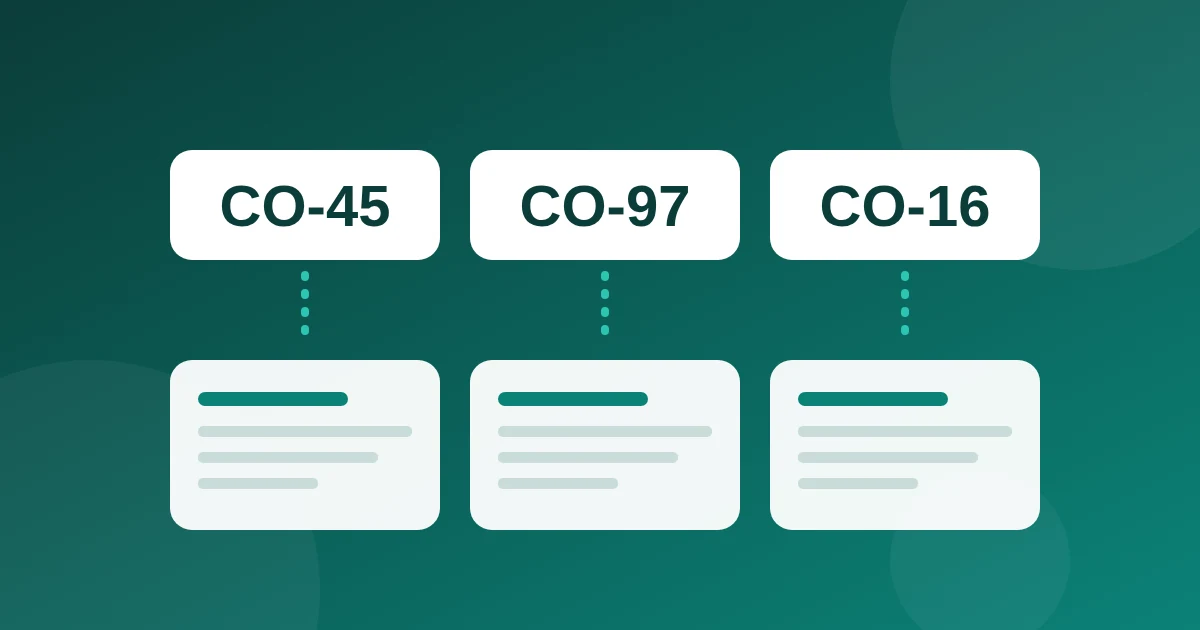
Open a remittance advice and you get a wall of letters and numbers. CO-45. PR-1. OA-23. Most of it looks like a secret language, but it's built from three simple parts, and once you know them the rest gets a lot less scary.
How to read a code
Every adjustment on a remittance has a group code, a reason code and sometimes a remark code.
The group code says who's responsible for the amount. CO is Contractual Obligation, which generally means the practice absorbs it under its payer contract. PR is Patient Responsibility, so the patient may owe it. OA is Other Adjustment, and PI is a payer-initiated reduction.
The reason code, called a CARC, is the "why." The remark code, called a RARC, adds the detail, and it's often the part that tells you what to actually fix. If you only read one of the two, read the remark code.
We go through the whole notice in how to read a claim denial. This post is the cheat sheet for the codes you'll see most.
The codes you'll see most
The meanings below come from the official X12 code list. The "first move" column is general practice, so always check the specific payer's rules and the remark code on your own remittance.
| Code | What it means | Usual first move |
|---|---|---|
| CO-16 | The claim or service lacks information, or has a submission or billing error. | Read the remark code to find the field, correct it, and resubmit. |
| CO-18 | Exact duplicate claim or service. | Check whether the first claim was already paid before sending anything again. |
| CO-22 | This care may be covered by another payer under coordination of benefits. | Confirm which insurance is primary and bill that one first. |
| CO-29 | The time limit for filing has expired. | Check the payer's filing deadline. Some payers consider a waiver with proof of why the claim was late. |
| CO-45 | The charge exceeds the fee schedule, maximum allowable or contracted fee. | Usually the contract at work. Make sure the write-off is posted correctly. |
| CO-50 | Non-covered because the payer does not consider it medically necessary. | Appeal with documentation that supports the need for the service. |
| CO-96 | Non-covered charge(s). | Read the remark code and the payer's coverage policy before deciding on an appeal. |
| CO-97 | The benefit for this service is included in the payment for another service that was already adjudicated. | Check the payer's bundling rule. If it applies, adjust it off. |
| CO-109 | Not covered by this payer. The claim has to go to the correct payer. | Find the right payer and send it there. |
| CO-119 | The benefit maximum for this time period has been reached. | Check how much of the benefit was used and whether another coverage applies. |
| CO-197 | Precertification, authorization or notification is absent. | See whether an authorization exists and is linked to the claim. Retroactive approval depends on the payer's policy. |
| CO-204 | The service is not covered under the patient's current benefit plan. | Check the group code. Under PR the patient may owe it, under CO the practice usually absorbs it. |
| CO-261 | The procedure or service is inconsistent with the patient's history. | Review the diagnosis and history on the claim against what was billed. |
| OA-A1 | The claim or service was denied. Used when no more specific reason code is available. | Look at the remark code. That is where the real reason should be. |
Two that people search for
CO-261 means the procedure or service doesn't fit the patient's history. When you see it, compare the diagnosis and history on the claim to what was billed, since a mismatch there is the usual culprit.
OA-A1 is a generic denial. The official guidance says to use it only when there's no more specific reason code, so the remark code carries the real explanation. If it's missing or vague, call the payer and ask.
A few habits that cut down on denials
Most of these codes trace back to the front desk, not the billing screen. Check eligibility before the visit, collect any other insurance at intake, and get authorizations in writing when a plan requires them. Keep track of filing deadlines, because CO-29 is the one denial you usually can't fix after the fact.
For behavioral health practices, a few extra points matter: documentation that supports why continued treatment is needed, and billing carve-out plans on their own claims. Our billing support for behavioral health covers how we handle this.
Appeal windows are often short. Check the deadline printed on the denial before you do anything else. And if you find yourself fixing the same code month after month, it's worth looking upstream at what keeps causing it. We list the usual suspects in why claims get denied.
If denials are eating your time, that's the work we take on. See our services, or drop us a note.
Quick answers
What does CO mean in a denial code?
CO stands for Contractual Obligation. It is a group code that tells you who is responsible for the adjustment. CO adjustments are generally the provider's to absorb under the payer contract, not the patient's.
What does CO-45 mean?
CO-45 means the charge exceeds the fee schedule, the maximum allowable amount, or the contracted fee. It usually reflects the difference between what you billed and what your contract allows.
What is the difference between a CARC and a RARC?
The Claim Adjustment Reason Code (CARC) says why a payment was adjusted or denied. The Remittance Advice Remark Code (RARC) adds detail, such as which field or document is the problem.
We also wrote a closer look at each of the three most common codes: CO-45, CO-97 and CO-16.
This article is general information, not billing or legal advice. Rules differ by payer, so confirm with the payer and your billing staff. Sources: X12: Claim Adjustment Reason Codes, Behave Health: Guide to denial codes.
Comments
No comments yet. Questions and thoughts are welcome.
Leave a comment